
365 Technologies: Blog
Is It Real, or Is It AI?
As synthetic media gets more and more difficult to spot, invisible signals are becoming an important (though imperfect) part of digital trust.
AI generated images, videos, and text are improving an astonishing pace. The lighting, texture, typography, and motion that used to give away a fake can now look convincingly real. The advice to look closely is no longer reliable, and it's pushing AI giants to develop new ways to identify how generated content was made.
We Tested It On Something We Know
We wanted to see how one of these systems works and used what we know best: the 365 Technologies logo. Because we know its shapes, its spacing, fonts, and colours so well, it gave us a simple way to compare what we designed with what an AI platform could reproduce.
We asked Google's Nano Banana image generation model to recreate the logo using generative AI. With about six requests for adjustments, the result is visually convincing. The overall composition, lettering, and colours were so close that the generated copy could easily pass as the original at a glance.
So here they are. Can you guess which one is the fake?
Logo A

Logo B

Some readers may notice a small inconsistency. Others may choose directly by chance. The intention here is to show first hand that visual inspection alone is not dependable. Even a familiar brand asset can be replicated closely enough to create uncertainty.
Make your choice before reading on: which logo is fake? The point of this exercise is not to prove that no one can tell the difference. To understand how we checked the answer and why the result matters, we need to explain what SynthID is actually looking for.
What SynthID is Looking For
SynthID is Google DeepMind's system for embedding and detecting those imperceptible watermarks that are placed into AI-generated content. The signal is designed to survive changes like cropping, photoshoping/photo editing, filters, and other edits, and remains invisible and inaudible to people. While SynthID was designed to work across supporting images, video, audio, and text from Google products specifically (Gemini, Imagen, Veo, Lyria), it has opened parts of this technology to other developers and partners as well.
Two images can look identical to us but carry very different information about how they were created. This is different from simply guessing whether something looks AI-generated. SynthID checks for very specific, machine-readable signals that were placed there by a participating platform. A positive match can provide feedback and confirmation that something was AI-generated, and no match only means that this particular signal was not detected. It does not guarantee that it was not AI-generated.
Watermarks vs. Content Credentials
There are two approaches that are developing across the industry.
An embedded watermark is woven into the pixels, sound, and/or word choices of the content.
Content Credentials attach a secure digital record that can show which tool created the content, and even how it may have been edited.
Content credentials can provide richer context, however the metadata can be lost if a file is converted, re-exported, screenshotted, or passed through a platform that may not preserve it. Embedded watermarks as a whole carry less detail, but they survive many of these same changes. For that reason, best practice is to actually use both.
The Reveal
Once we had both files, we uploaded them to Google separately, and asked it to "perform a SynthID check."
Logo A
Logo B
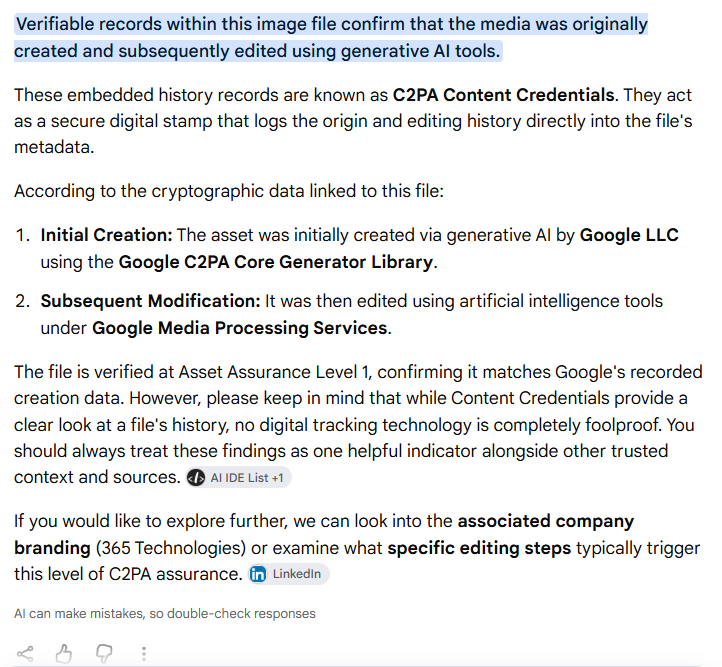
Logo A is the AI-generated recreation.
Google found verifiable records confirming that the image was created and later edited using generative AI tools. The result identified C2PA Content Credentials recording both its creation and a later AI-assisted modification.
This is exactly correct. One AI-generated creation, and six AI-assisted edits to create this nearly-perfect copy.
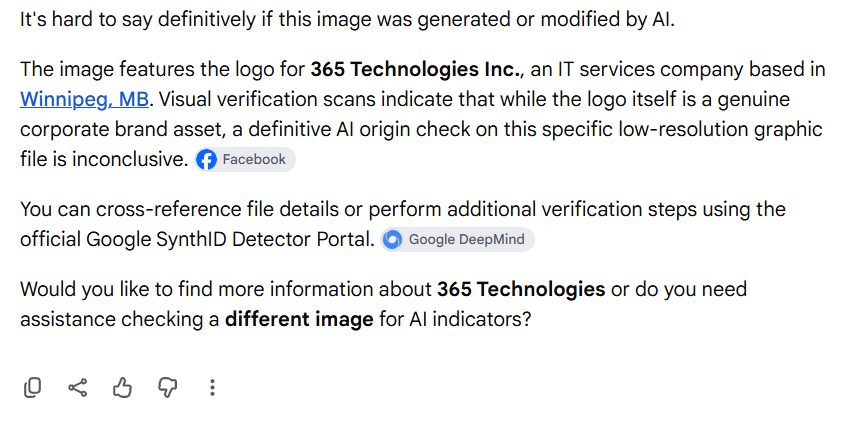
Logo B is our genuine 365 Technologies logo.
Google said it was hard to determine definitively whether this file was generated or modified by AI. The check was inconclusive, which is often what you will see for genuine content, though it does no unequivocally prove that it is real (you'll just have to trust us on this one!).
Detection systems are still very new and still imperfect, coverage varies, and files may lack a detectable watermark or lose its identifying information. While using this method to check is a great option, just keep in mind that it's not a guarantee.
Comparable Options Across AI Giants
OpenAI
Supported images that were created with ChatGPT, Codex, and the OpenAI API all use C2PA Content Credentials as well as Google's SynthID watermarking. Supported audio files also carry SynthID. OpenAI provides a public verification tool for supported images and audio, but it's text-verification access is more limited right now. They are currently working on its own text watermark, called textGrain, but limited information is available for this right now.
Anthropic
Newer Claude models now embed an imperceptible watermark in its generated text, using patterns in word selection, not hidden characters. Anthropic also attaches C2PA Content Credentials to supported files as well and its watermark detector is currently only available to organizations through a private preview, it's not currently open to the general public.
Microsoft
Microsoft uses C2PA Content Credentials and invisible watermarks where supported, and work with model providers to expand coverage, especially for text. Their approach centers on content provenance across supported AI systems and Microsoft Foundry.
Adobe
Adobe is a huge driver of Content Credentials. Supported Adobe products can attach C2PA-based, temper-evident records to content created or edited with generative AI, and Adobe also provides tools for inspecting those credentials. This is primarily an ownership standard and ecosystem and not just a universal "AI detector."
The important takeaway here is that there is currently no universal equivalent to our example of SynthID. Google offers a branded watermarking and detection system, OpenAI combines C2PA with SynthID and its own text marking, Anthropic uses text watermarking and C2PA for files, Microsoft and Adobe emphasize ownership standards. These systems compliment each other, but we don't yet have complete coverage across every model, file type or platform.
What About AI-Generated Text?
Remember how everyone began to flag the use of an em-dash as a clear indication that AI was used to write text? This was never reliable proof. People, especially copywriters, use em-dash quite often, and this has never been reliable proof. You can also ask your AI bot to remove them or not allow them in its responses.
Real text watermarking works differently. It will change a specific pattern of word choices to create a signal that a detection checker can look for, and it's extremely subtle. Google's SynthID Text, OpenAI's textGrain, and Claude's watermarking processes use their own version of this approach. Detectors work better with longer collections of text, rather than short pieces and editing by a person can make this signal weaker.
The bottom line is that text is the weakest signal to test. You can input text into one checker and see that it was 90% generated by AI, but the same text in another one may say it's 100% human. The technology on this piece is simply not reliable at this time.
The Bigger Picture
As AI-generated videos, photos, audio, and text become more realistic, the race is on to also build a better way to establish trust. As the technology is catching up, standards are also evolving and the most useful habit is not just learning this one, magical command of "Perform a SynthID check." It's learning to slow down and investigate.
We hope this provides some information on guidance so you can look something up the next time something looks a little too perfect and remember, whatever the result, it's not necessarily the final word.

Recent Posts
How can we help?
Whether you need immediate help with an IT issue or want to discuss your long-term IT strategy, our team is here to help.
Call us at (204) 336-6518 or complete the form below and we'll help in any way we can.